

Description
Giraffe
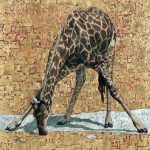
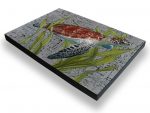
By Marc Alexander from his ‘In The Balance‘ series. Giraffe, oil and gold/silver leaf on canvas, 100cm by 100cm, (2015).
The giraffe (Giraffa camelopardalis) is an African even-toed ungulate mammal, the tallest living terrestrial animal and the largest ruminant. Its species name refers to its camel-like shape and its leopard-like colouring. Its chief distinguishing characteristics are its extremely long neck and legs, its horn-like ossicones, and its distinctive coat patterns. It is classified under the family Giraffidae, along with its closest extant relative, the okapi. The nine subspecies are distinguished by their coat patterns.
The giraffe’s scattered range extends from Chad in the north to South Africa in the south, and from Niger in the west to Somalia in the east. Giraffes usually inhabit savannahs, grasslands, and open woodlands. Their primary food source is acacia leaves, which they browse at heights most other herbivores cannot reach. Giraffes are preyed on by lions; their young are also targeted by leopards, spotted hyenas, and African wild dogs. Giraffe are gregarious and may gather in large aggregations. Males establish social hierarchies through “necking”, which are combat bouts where the neck is used as a weapon. Dominant males gain mating access to females, which bear the sole responsibility for raising the young.
The giraffe has intrigued various cultures, both ancient and modern, for its peculiar appearance, and has often been featured in paintings, books, and cartoons. It is classified by the International Union for Conservation of Nature as Least Concern, but has been extirpated from many parts of its former range, and three subspecies are classified as Endangered. Nevertheless, giraffes are still found in numerous national parks and game reserves.
Archival Prints
Many of Marc’s artworks are available as fine art digital prints. Professionally photographed and printed on large format inkjet printers, these prints are limited edition numbered bottom left and signed bottom right. The paper used is 320g Hahnemuhle archival watercolour paper or Van Gogh cotton canvas. The process employs fade resistant, archival inks, which boast a 100+ year fade-proof guarantee.
These prints are also available in varying sizes. The paper prints are sold plastic wrapped on an acid-free foamcore backing board. The prints on canvas can be provided stretched or rolled in a core for easy transporting. The canvas print is treated with a high quality scratch resistant matt art-sealant. Directly behind the stretched canvas print is a fixed board which gives the frame rigidity, prevents warping and ensures the frame hangs flush against the wall. Large frames are cross braced to further prevent warping.













Reviews
There are no reviews yet.